Research Paper
Autonomous Radar Ornithology: Benchmarking Automated Bird Detection and Tracking
A new study demonstrates how automated radar systems can improve the monitoring and tracking of seabirds in offshore environments, particularly where manual analysis is impractical. The paper, “Autonomous Radar Ornithology: Benchmarking Automated Bird Detection and Tracking,” evaluates the performance of GANNET (the GlobAl Nearest Neighbour targEt Tracker), a low-cost and customisable system designed to detect and track bird-like targets in X-band marine radar imagery.
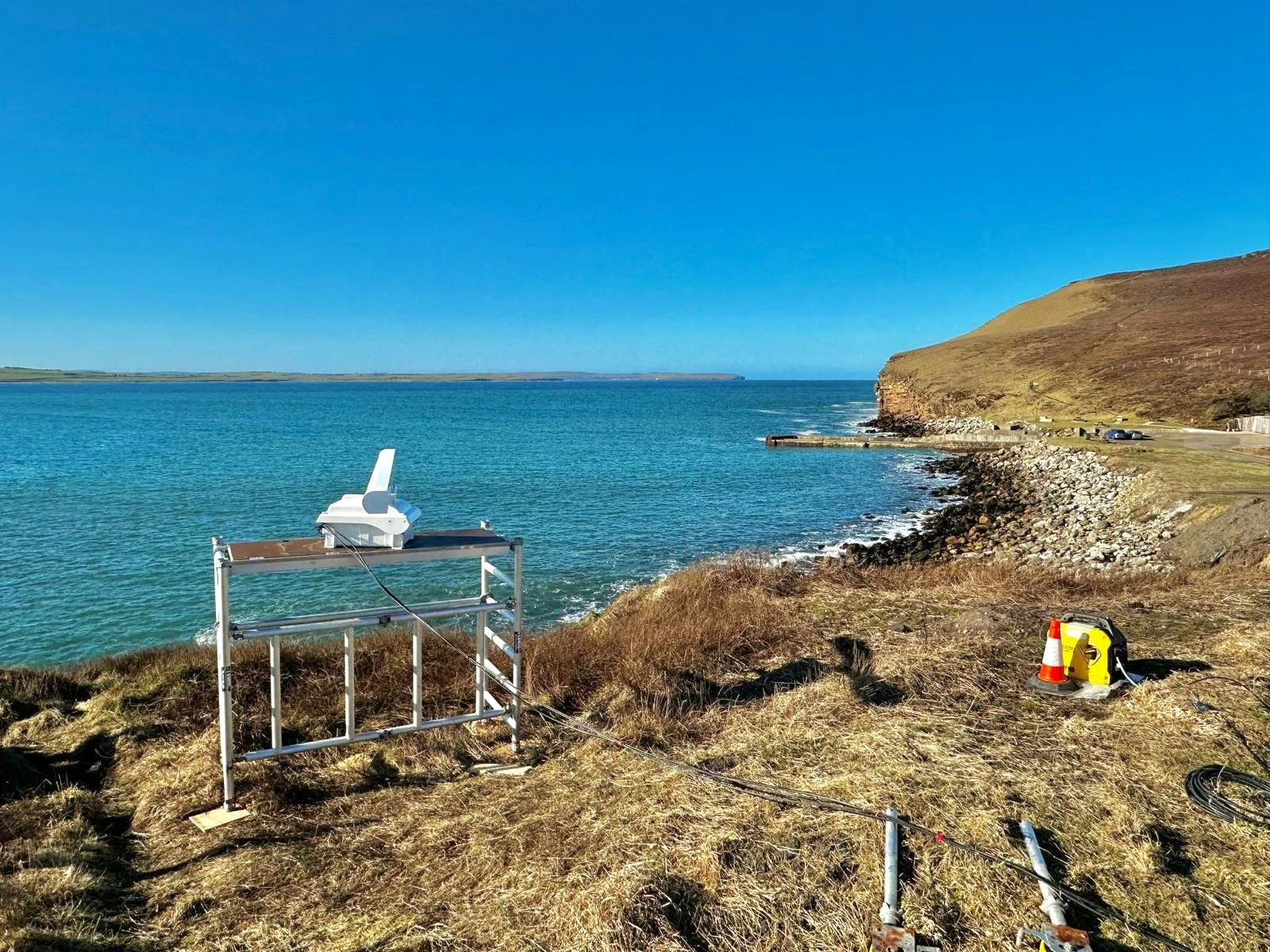
The study was led by Amy Jones, an ERI-based researcher, and focuses on improving the efficiency and reliability of radar-based bird monitoring in complex marine environments. The work was carried out using data from the Fall of Warness tidal test site in Orkney, a key location for marine renewable energy research and environmental monitoring.
Radar has been used to study bird movement since the 1960s, but increasing data volumes and the complexity of offshore environments have made manual analysis increasingly difficult. This study demonstrates how automation can address these limitations by rapidly processing large radar datasets while maintaining robust detection and tracking performance.
Across more than 55 000 radar detections and over 34 000 reconstructed flight trajectories, GANNET was found to process data more than ten times faster than manual annotation. It also showed improved sensitivity in medium- and low-quality imagery, where human interpretation typically becomes less reliable.
The system’s ability to consistently detect and track bird-like targets across large datasets highlights its potential for long-term environmental monitoring, as well as retrospective analysis of archived radar data. This is particularly relevant for marine renewable energy sites, where understanding seabird activity is important for environmental assessment and mitigation.
Monitoring birds using marine radar is challenging due to environmental clutter such as waves, rain, vessel reflections, and low-intensity returns from small birds. These factors can obscure biological signals and complicate automated detection.
GANNET addresses these challenges through a multi-stage processing approach that combines adaptive thresholding, clutter suppression, target grouping, and statistical tracking methods. The system links sequential radar detections into flight paths using a global optimisation approach and maintains track consistency using predictive motion modelling.
The study highlights that while the system performs well overall, performance varies under high-clutter conditions, and certain flight behaviours—particularly more erratic or foraging movements—can be harder to maintain as continuous tracks. These limitations reflect broader challenges in radar ornithology and point to areas where future improvements are needed.
The findings support the growing use of automated radar systems in marine conservation and renewable energy contexts. Offshore wind and tidal developments require robust monitoring tools to assess potential interactions between infrastructure and wildlife, particularly seabirds that travel large distances and operate in visually challenging environments.
Compared with manual approaches, automated radar tracking provides continuous, objective monitoring that can operate over long time periods and across large spatial scales. This makes it particularly valuable for both baseline ecological studies and ongoing impact assessment.
The study concludes that GANNET represents a promising and scalable approach to seabird radar tracking, with strong potential for further development through improved clutter suppression, enhanced motion modelling, and integration with complementary sensing technologies.
Publication details: