Funding Award
IBioIC Feasibility Fund award supports circular biochar solution for wastewater treatment
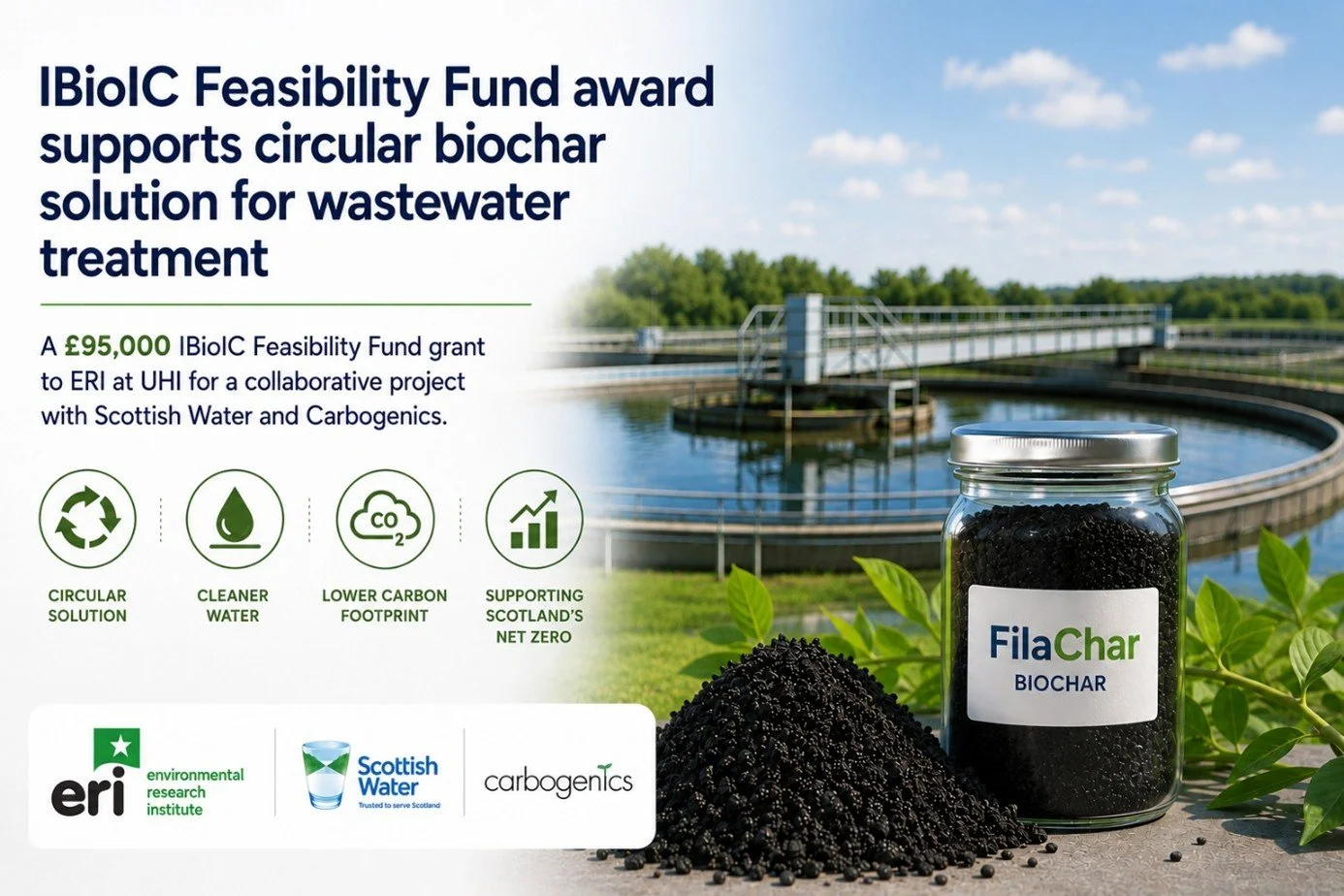
The Environmental Research Institute (ERI) at the UHI North, West and Hebrides has been awarded a £95,000 IBioIC Feasibility Fund grant for a new collaborative project with Scottish Water and Carbogenics. The six month project will begin in June and will advance an innovative biochar based solution for wastewater treatment, supporting Scotland’s circular economy and net zero ambitions.
The project responds directly to the recast Urban Wastewater Treatment Directive, which will require larger wastewater treatment works (>150,000 population equivalent) to introduce quaternary treatment to remove micropollutants before effluent is discharged into the environment. Anticipating these regulatory changes, Scottish Water is exploring more sustainable alternatives to conventional materials such as granular activated carbon (GAC), which are widely used across Europe but carry significant cost and carbon burdens.
At the centre of the project is FilaChar, a patent pending biochar developed by Carbogenics using wastewater treatment biological screening waste that would otherwise be sent to landfill. Produced through pyrolysis, FilaChar represents a circular solution that transforms an unavoidable waste stream into a high value treatment material.
Through this new feasibility project, ERI, Scottish Water, and Carbogenics will work together to advance FilaChar from early proof of concept (TRL 2) to validation in a real world operational environment (TRL 5). The material will be tested using ERI’s FiltraFlo pilot filtration unit at the Scottish Water Horizons Development Centre in Bo’ness, assessing removal of priority pollutants from real wastewater effluents.
Dr Szabolcs Pap, Project Lead at ERI, welcomed the award:
“This project represents continued engagement with both the water and biochar sectors to advance Scotland’s circular economy agenda and support the transition of the water industry toward net zero in the coming years. By working closely with Scottish Water and Carbogenics, we can accelerate the development of low carbon treatment solutions that deliver both environmental and economic benefits.”
The project exemplifies industrial biotechnology by integrating thermal conversion, waste valorisation, and advanced separation processes into a scalable treatment solution. If feasibility validation is successful, the work could progress to larger scale demonstrations across Scottish Water sites, with future studies expanding pollutant scope to include emerging contaminants such as PFAS. Longer term opportunities may also include exploration of carbon credit markets and follow on funding through Innovate UK programmes.
https://www.ibioic.com/funding-calls-database/feasibility-funding