
Overview
Pharmaceutical Reduction in the Water Environment through Sustainable Healthcare (PhRESHWater) is a new two year £1.19 project funded by the UK Research and Innovation. Led by the University of the Highlands and Islands (UHI) with The James Hutton Institute, NHS Highland, the University of Nottingham, Heriot Watt University, and University of St Andrews, the project seeks to co-develop a systems-based approach to address pharmaceutical pollution in the water environment.
By using Scotland as a pilot, the project draws together an interdisciplinary team across environmental, materials, biomedical, biological, and social science, alongside key partners at Scottish Water, the Scottish Environment Protection Agency (SEPA), and Uppsala University in Sweden.

“By bringing together expertise from multiple disciplines and sectors, we can develop practical solutions that help protect both ecosystem and human health while supporting more sustainable healthcare systems.”
Background & aims
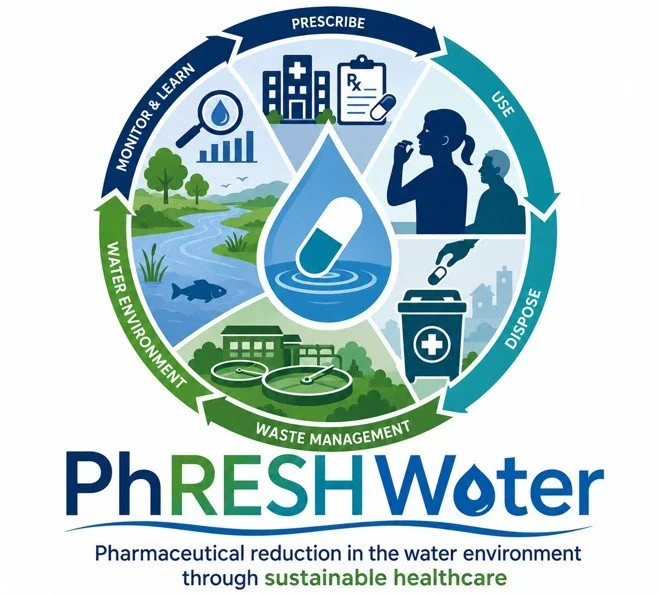
Pharmaceutical pollution in the water environment is an internationally recognised public health and environmental issue. Pollution arises across the pharmaceutical lifecycle, including from prescribing, use, disposal, and wastewater treatment. To comply with evolving regulations, the healthcare and water sectors face mounting pressures to improve practices, reduce costs, and deliver environmental sustainability targets.
Pharmaceutical Reduction in the Environment through Sustainable Healthcare (PhRESHWater) will apply a One Health systems-based approach bringing together cross-sector researchers and practitioners to deliver targeted innovation at multiple stages of the pharmaceutical lifecycle.
The project is built around four interconnected work packages:
Risk Modelling: Establish a systems-based model to identify pollution hotspots across 40 Scottish catchments, using prescribing, environmental monitoring, and wastewater treatment data.
Behaviour Change: Co-develop recommendations for prescriber and public awareness and actions to support environmentally informed prescribing and disposal.
Pollution Reduction: Evaluate interventions to reduce high risk pharmaceuticals entering the environment, including testing novel treatment technologies to enhance pharmaceutical removal in wastewater.
One Health Integration: Apply a One Health framework to foster interdisciplinary collaboration and shared decision-making tools to enable coordinated cross-sector action.
PhRESHWater builds on a strong foundation of collaboration through the One Health Breakthrough Partnership (OHBP), which unites Scottish researchers, public agencies, and policymakers in addressing pharmaceutical pollution and provides a robust platform for co-designing project activity.
The project will generate new evidence, tools, and resources to support coordinated action on pharmaceutical pollution, helping to safeguard environmental and human health while enabling the healthcare and water sectors to meet sustainability goals.
Project updates
Project updates will be posted on the One Health Breakthrough Partnership’s website and project page.

Grant details
UKRI grant reference: UKRI3744
Funder: Medical Research Council UKRI
Funding Opportunity: OPP912: UKRI Cross-Research Council Responsive Mode pilot scheme (Round 2).
For more information, please contact:
Professor Stuart Gibb, principal investigator: stuart.gibb@uhi.ac.uk
Dr Lydia Niemi, project manager: lydia.niemi@uhi.ac.uk