Research Paper
An individual-based model to quantify the non-breeding season impact of wind farms on seabirds
A new study co-authored by Dr Elizabeth Masden of the Environmental Research Institute (ERI) has developed a powerful new modelling tool to assess how offshore wind farms may affect seabird populations during the non-breeding season, a period that remains poorly understood but is critical to seabird survival.
The paper, “An individual-based model to quantify the non-breeding season impact of wind farms on seabirds”, was published in Ecological Solutions and Evidence (Volume 7, Issue 1) and is available as an Open Access article.
Offshore wind energy is expanding rapidly as countries work to meet renewable energy targets. While this transition is essential for addressing climate change, offshore wind farms can also pose risks to wildlife, including seabirds. These risks include both:
Lethal impacts, such as collisions with turbine blades
Sub-lethal impacts, such as displacement from important feeding areas, which may lead to reduced body condition or survival
However, much of what we know about seabird vulnerability is focused on breeding season behaviour, when birds are tied to colonies. Far less is known about how seabirds use marine habitats during the non-breeding season, and how developments may affect them during this time.
To address this knowledge gap, the authors developed an individual-based model designed to simulate seabird behaviour across the non-breeding season. Using long-term tracking datasets collected from geolocation–immersion loggers, the model estimates population-level movement patterns and activity budgets. It then simulates individual behaviour, movement, and interactions with offshore wind farms, including collision risk and displacement effects.
The model was demonstrated using two seabird populations breeding in Norway:
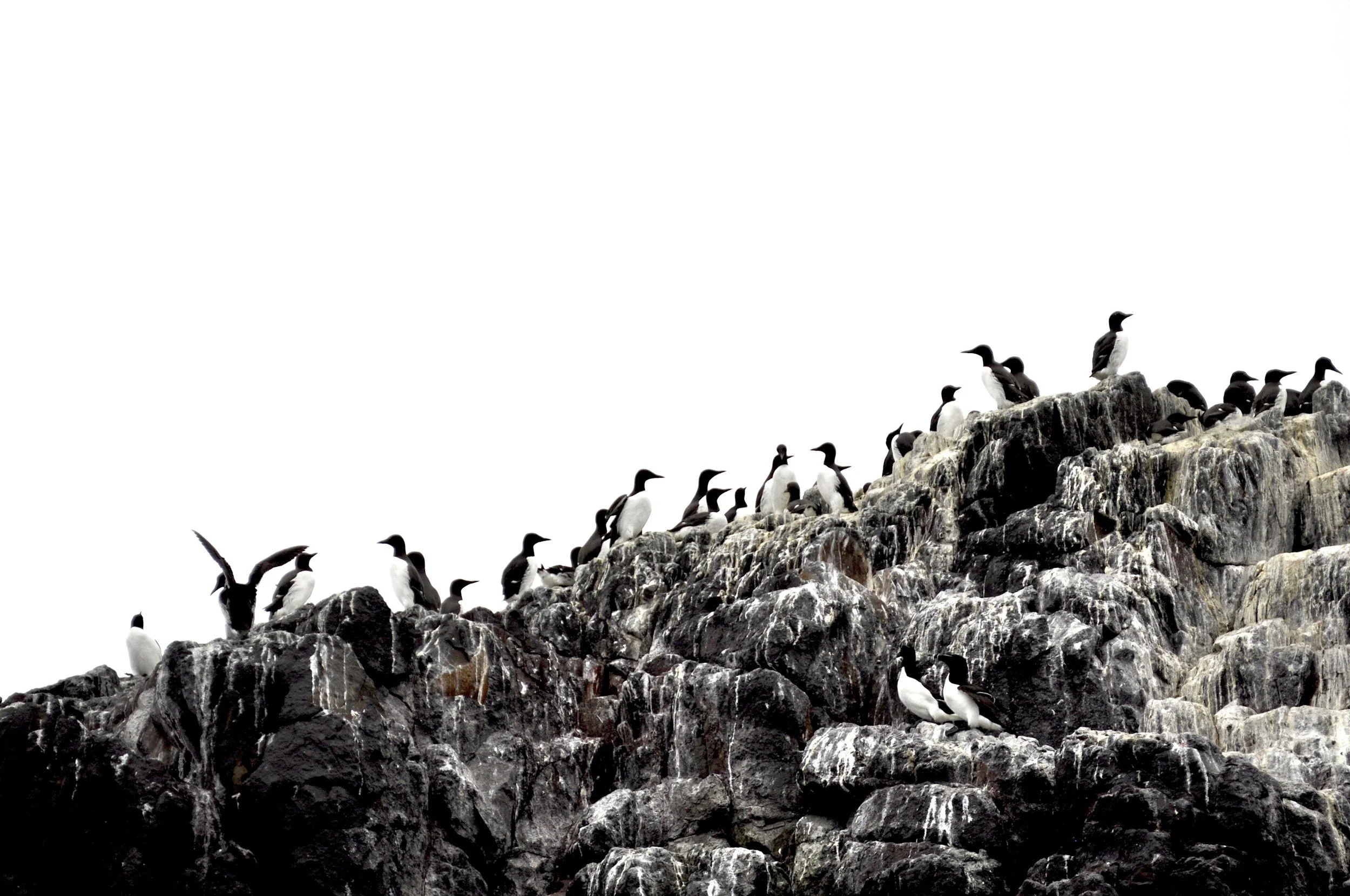
Common guillemots (Uria aalge) breeding at Sklinna
Black-legged kittiwakes (Rissa tridactyla) breeding at Ålesund
The study tested the potential impacts of 10 simulated offshore wind farms, focusing on:
Displacement effects in guillemots (sub-lethal impacts)
Collision risk in kittiwakes (lethal impacts)
The model predicted that:
49.6% of guillemots from the Sklinna breeding population would experience displacement effects during the non-breeding season
Because the energetic cost of displacement remains uncertain, multiple scenarios were modelled, with:
potential adult mortality ranging from 0% to 5.32%
end-of-season body masses at 97.12%–99.84% of the unimpacted scenario
For kittiwakes, the model found that:
98.9% of individuals flew through at least one wind farm footprint
yet predicted collisions occurred in only 0.055% of the population
this low predicted mortality was largely due to limited overlap between turbine rotor height and likely kittiwake flight height
The study provides an important step forward in the development of evidence-based tools to support environmentally responsible renewable energy development. It also identifies key knowledge gaps, especially around the energetic consequences of displacement, as priorities for future research to reduce uncertainty.
The model is designed to be reproducible and adaptable, meaning it could be applied to other seabird species, other regions, or additional marine pressures beyond offshore wind farms.
Read the full paper:
Buckingham, L., Masden, E.A., Layton-Matthews, K., et al. (2026) An individual-based model to quantify the non-breeding season impact of wind farms on seabirds
Ecological Solutions and Evidence, 7(1), e70196
https://doi.org/10.1002/2688-8319.70196